
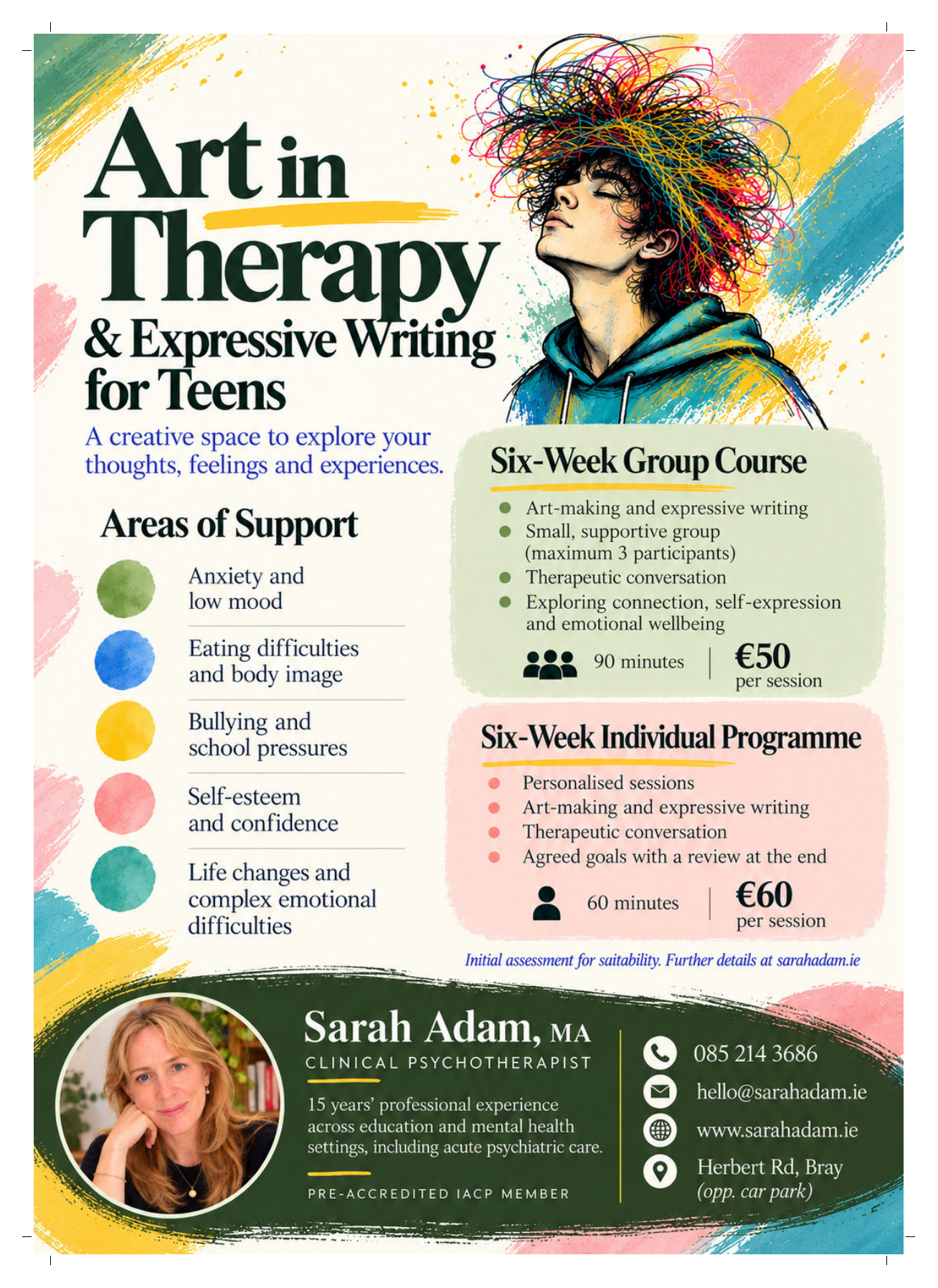
Art in Therapy & Expressive Writing for Teenagers
Ages 12–18 | Individual sessions and small-group programmes |
“The creative process is a healing process.” Natalie Rogers (1993).
Most teens can talk about pretty much anything except what’s bothering them.
They might be doing fine in the classroom, have mates, seem to be getting on okay
in general and yet be suffering internally with anxiety, a sense of isolation, anger or
just a constant feeling that they’re not good enough.
Others find it very hard to put their experience into words, especially when they’re
overwhelmed.
Art and creative writing in general provide another avenue to start with. They give the
young people something to concentrate on, something to get involved with and at
times something to talk about.
Art doesn’t have to be talking. It can in fact be the very thing that makes
talking possible.
Why I work this way
Before training as a psychotherapist I spent many years as an art teacher in post-
primary schools, including many years as an art teacher at CHI Crumlin.
I’ve met teenagers with severe eating disorders, self-harm, suicidal ideation and a
huge amount of emotional distress. A lot of them were intelligent, articulate and
capable young people who struggled with feelings of shame, worthlessness and
isolation.
I became interested in how they responded to the simple act of creation. It opened
up the space to be someone else, to feel something else.
I recall working with a little girl who for a good while would only respond to me with
one syllable answers. She wouldn’t talk at all for weeks. We slowly got into her world,
started painting together (no pressure to talk at all) and from that point on the
conversations came. The art was something we could both go back to and the
relationship developed from there.
They'd soften as they worked, their shoulders would relax, the tension would ease.
All the patients looked forward to their art sessions. It was a welcome relief from
being & prodded with needles and tubes and the endless questions about their
medical condition. I got the sense from the feedback parents were giving me there
was more to this. The patients were opening up and finding room to express
themselves.
Those experiences were pivotal in my decision to train in psychotherapy.
The parents I met in those hospital wards along with the wider medical teams were
absolutely brilliant and extremely supportive of the artwork. It didn’t however
overshadow the very real sense of worry that so many of the mothers had. They
were worried for their child, they were worried about how they could possibly help
and they were very much in fear that every attempt they made to get to their
teenager was just driving them further and further away.
I could see the strain on both sides.
It left me with the very distinct feeling that young people and families across the
wider community could be served by a different approach to working with them. An
approach that would combine creative expression with an understanding of the
psychological needs of the young person and which would be one in which the
young person didn’t have to be on display or perform.
What actually happens in a session?
Each activity has a purpose really. We could be looking at anxiety, self esteem,
friendships, family relationships, difficult emotions, the pressure to conform etc.
I draw on establised approached of Natalie Rogers who believed that when people
are free to paint, write, move and create without fear of judgement, they can discover
parts of themselves that words alone might never reach.
Inner-Self/Outer-Self Collage
This exercise is about the difference between the way we present ourselves to
others and the way we actually experience ourselves in private.
I might invite a teenager to divide a page in two.
On one side, they use images, words or colours to represent the person other people
see. On the other, they create something that reflects how they actually feel inside.
A teenager might describe themselves as funny and sociable at school, while
privately feeling anxious, exhausted or lonely.
We might explore questions such as:
Which side is doing the most work?
Is there anywhere you feel you can be yourself?
What do you wish people would understand about you?
For some young people this can open up a discussion around friendships,
confidence or the pressure to seem happy.
For others who mask,, it may be a chance to help them recognise how exhausting
everyday life can be.
Body Mapping Exercise
Feelings are hard to put into words for most of us and even harder for teenagers. We
can however be quite aware of them on a physical level.
Using an outline of the body we look at where they feel the tension, the discomfort,
the energy and the strength.
Anxiety may well manifest as a tightness in the stomach. Anger may be associated
with heat or restlessness. Worry can make it very difficult to settle or to sleep.
We can start noticing these experiences and explore what helps.
They doesn’t have to identify any sensations at all, or indeed share anything they
find uncomfortable.
We go at their pace.
Expressive Writing and Visual Journals
Writing, making lists, combining words with images or indeed keeping a visual
journal is all excellent ways of externalising your emotions.
What do people get wrong about me?
What do I wish I could say?
When do I feel most like myself?
Here are for some free downloads on this topic
More than an art class
I’ve spent 15 years teaching art and I know how easily a young person can get
daunted when something doesn’t work out.
They might say they’ve destroyed a painting, that they’re absolutely useless at
drawing, that there’s no point in carrying on.
I don’t see those moments as simple problems with the artwork.
Sometimes they’ll tell you something about how a young person reacts to making a
mistake, to disappointment, to their own expectations.
We might change direction, experiment with another material or decide to begin
something new. The important thing isn’t producing a beautiful piece of work.
It is having an experience in which mistakes are manageable, ideas can change and
the young person has some control over what happens next.
ADHD, Autism & a New Diagnosis
My approach is informed by my experience in education and psychotherapy and five
years of volunteering with ADHD Ireland.
I work with young people who have just been diagnosed with autism or ADHD and
those who have had a diagnosis for some time and who still find school, friends and
the general expectations of life very difficult.
A diagnosis can be a source of relief and clarity. It can also lead to questions about
who you are, where you fit in and the sheer effort it can take to be accepted as part
of a group.
I don’t expect every teenager to work in the same way.
Some like very clear instructions and structure, others like the freedom to
experiment. Some have a preference for certain materials, others find certain
textures, sounds etc. very uncomfortable. This can be discussed at the initial
consultation. See here for assessment form.
We can modify the activities, give people choices, take a break or change direction.
There is absolutely no requirement to make eye contact, to sit still for the whole of
the session or to be 'feeling it' at any given moment.
My interest is in helping young people to understand their own needs and their own
strengths rather than teaching them to hide their differences.
Who might benefit?
Art in Therapy & Expressive Writing may be helpful for teenagers experiencing:
Anxiety, low mood or emotional overwhelm
Low self-esteem, self-criticism or difficulties with confidence
Bullying, friendships and school pressures
Eating difficulties or concerns about body image
Family conflict, separation, grief or significant life changes
Difficulties with emotional expression, identity or belonging
Challenging behaviour associated with ADHD, autism or masking
The programme is not a replacement for specialist psychiatric or multi-disciplinary
treatment where that is required. Suitability is assessed on an individual basis,
particularly in the case of significant eating difficulties, self-harm or suicidal ideation.
Six-Week Individual Programme
60-minute sessions | €60 per session
Individual sessions offer a more personalised approach.
We begin by understanding what the young person is finding difficult and what they
would like to be different.
Sessions may combine art-making, expressive writing and therapeutic conversation.
The balance depends on the individual.
Over six weeks, we can explore particular concerns, notice emerging patterns and
begin developing ways of understanding and managing difficult experiences.
At the end of the programme, we review what has been helpful and consider whether
further support would be appropriate.
Six weeks isn't a promise to resolve every difficulty. It offers a structured starting
point.
Six-Week Small-Group Programme
Maximum three participants | 90 minutes | €50 per participant, per session
Some teenagers benefit from working alongside others.
In a small group, we explore themes such as identity, confidence, friendships,
emotions and self-expression through creative activities.
Each young person works on their own pieces, with opportunities for conversation
and reflection.
No one is obliged to reveal their personal experiences or to share their art.
Keeping the group down to a maximum of three enables me to attend to the
individual needs of each and to maintain a manageable group.
A preliminary assessment will help establish whether the group is appropriate for
each individual.
For parents
It can be painful to watch your teenager struggle, particularly when they don't want to
talk about what is happening.
Sometimes the more you try to help the further away they seem.
That doesn't necessarily mean they don't need you.
Adolescence is a complex journey towards independence. The young person may
be wanting privacy and autonomy, but will still require reassurance, connection and
the knowledge that someone is looking out for them.
My job is to recognize that growing independence whilst at the same time
acknowledging the very real role that parents and carers still have to play.
The initial consultation
Before beginning, we arrange an initial consultation to understand the your child’s
needs, relevant history and what support might be most appropriate.
This includes an opportunity to hear from parents or caregivers and from the
teenager themselves.
We discuss confidentiality, safeguarding, expectations and how parents can be
appropriately involved.
Background
MA Clinical Psychotherapy | Qualified Art Teacher | Pre-accredited IACP
Member
I bring together psychotherapy and 15 years of experience in art education and
mental health settings, including working with young people experiencing acute
psychological distress at Children's Health Ireland, Crumlin.
I am fully registered with the Teaching Council and have undertaken additional
professional development in art therapy approaches, self-compassion and body-
oriented psychotherapy.
I have also volunteered with ADHD Ireland for five years.
My therapeutic approach is relational and trauma-informed. I am particularly
interested in how young people come to understand themselves, how shame and
self-criticism develop, and how creative work can make difficult experiences easier to
approach.
I believe young people deserve to be taken seriously, even when they cannot explain
exactly what is wrong.
Enquiries
If you are considering individual sessions or a small-group programme for your
teenager, please get in touch to discuss suitability and the next steps.
See the resources page for some free downloads to try some exercises at home.
Sarah Adam Psychotherapy
Herbert Road, Bray, Co. Wicklow (opposite the car park)
Phone: 085 214 3686
Email:hello@sarahadam.ie
Website:www.sarahadam.ie